
Research teams
Genetics, cell biology and development department
mRNA regulation and development

Video: https://www.youtube.com/watch?v=WyF9sFy02D0
mRNA regulation by piRNAs in early embryos
piRNAs (Piwi-interacting RNAs) are small non-coding RNAs that repress transposable elements in the germline of animals. Our lab pioneered the discovery of a new function of piRNAs and PIWI proteins in gene regulation. We found that piRNAs produced from transposable element sequences are essential to embryonic development through the regulation of maternal mRNAs. These studies allowed us to propose the concept of gene regulation by piRNAs and of a developmental function of transposable elements. This function of piRNAs and PIWI proteins in gene regulation was confirmed throughout evolution and in a wide range of biological processes.
Deciphering the molecular mechanisms of mRNA regulation by piRNAs and the PIWI protein Aubergine (Aub) that binds piRNAs, we found that targeting of maternal mRNAs by piRNAs leads to their decay in the somatic part of embryos (Rouget et al. Nature 2010; Barckmann et al. Cell Report 2015), and to their stabilization and translation in the future germline (the germ plasm) (Dufourt et al. Nature Communications 2017; Ramat et al. Cell Research 2020). Maternal mRNA decay in the soma and translational activation in the germ plasm by Aub and piRNAs are essential for embryo patterning and germ cell development, respectively (see Review : Wang*, Ramat* et al. Nature Reviews Molecular Cell Biology 2023).
mRNA regulation by piRNAs in germline stem cells
piRNAs and PIWI proteins play also important functions in various populations of stem cells and they are thought to be part of an ancestral gene repertoire involved in stemness. We have previously shown that piRNAs and the PIWI protein Aub are required for the self-renewal of germline stem cells (GSCs) in the Drosophila ovary and we have identified a relevant Aub mRNA target for this regulation, the Cbl proto-oncogene (Rojas-Rios et al. EMBO Journal 2017). Following these findings, we found that Aub binds several glycolytic mRNAs and activate their translation. We developed tools to record metabolism in vivo, in GSCs and showed that Aub and piRNAs activate glycolysis in GSCs. Stem cells are known to undergo a metabolic reprogramming towards glycolysis, however the molecular mechanisms are poorly understood. Here, we uncover a totally new level of regulation of stem cell metabolic reprogramming based on piRNAs and PIWI proteins (Rojas-Rios et al. Nature Communications 2024).
Aub and piRNAs are expressed in both GSCs and differentiating cells at similar levels, therefore a specific regulation in these two cell types is expected to require cell-specific Aub cofactors. We have identified several potential Aub cofactors and aim to address their function and cooperation with Aub in stem cell fate through metabolic regulation.
mRNA regulation by RNA granules
Anne Ramat
RNA granules are membraneless biomolecular condensates composed of RNAs and RNA binding proteins. Their organization and functions have attracted tremendous interest in the recent years, since most aspects of mRNA life are linked to their formation. Our study of Aub function in translational activation of germ cell mRNAs in the germ plasm initiated a new project related to RNA granules, as the germ plasm is composed of a specific type of RNA granules, the germ granules. Our question was to decode the functional compartmentalization of germ granules that were known to ensure both mRNA translational repression and activation. Using super-resolution microscopy and advanced single-molecule imaging approaches to record translation, we showed that germ granules are composed of two immiscible phases, the core where mRNAs are compacted and repressed, and the shell where translation takes place. These findings reveal the tight links between RNA condensate architecture and functions (Ramat, Haidar et al. Nature Communications 2024).
Building on these results showing the biphasic architecture of germ granules, our projects aim to understand the molecular and biophysical aspects of the relationships between granule organization and their different functions. We are using various approaches to tackle this question, as follows.
- Purification of germ granules by FAPS (Fluorescence-Activated Particle Sorting) to identify their RNA and protein contents.
- Identification of Aub domains and interactors for translational activation.
- Implementation of artificial granules in Drosophila embryos as simplified models of RNA granules.
- Understanding the relationships between germ granules and their cellular environment.
Role of m6A mRNA methylation in maternal mRNA regulation
mRNA modification or “epitranscriptomics” has emerged has a new layer of gene regulation. Being the most abundant modification in mRNAs, the N6-methyladenosine (m6A) modification is a key player of post-transcriptional gene regulation. m6A is highly enriched in maternal mRNAs and contribute to maternal mRNA decay in several species, mostly through the cytoplasmic m6A reader Ythdf2. We are investigating the importance of m6A in maternal mRNA decay in Drosophila embryos, using genetics and cutting-edge genomic approaches to quantitatively record m6A sites on mRNAs. We address the following questions.
- To decipher the molecular mechanisms of m6A-dependent maternal mRNA decay.
- To investigate a potential role of m6A in translational regulation of maternal mRNAs.
- To understand the relationships between m6A-dependent controls in mRNA stability and translation.
Pathophysiology of Oculopharyngeal muscular dystrophy using the Drosophila model
Aymeric Chartier
We have developed a Drosophila model of a rare genetic disease, oculopharyngeal muscular dystrophy (OPMD) that is characterized by the progressive degeneration of specific muscles. OPMD is due to short alanine expansions in Poly(A) binding protein nuclear I (PABPN1), a protein involved in polyadenylation. Mutant PABPN1 forms aggregates in muscle nuclei from patients; these aggregates are pathological RNA condensates composed of RNAs and RNA binding proteins.
We used a large set of approaches to identify i) molecular pathways involved in OPMD pathogenesis and ii) small molecules that might be relevant in future therapeutic strategies. We identified several molecular pathways contributing to OPMD, among which, reduced mitochondrial activity that corresponds to the earliest molecular defect in the disease (Chartier et al. PLOS Genetics 2015); the ubiquitin-proteasome system (Ribot et al. PLOS Genetics 2022); and the endoplasmic reticulum (ER) stress (Naït-Saïdi et al. Open Biology 2023). We are currently investigating the role of ribosomal RNA surveillance in the disease.
We have reported several small molecules showing a beneficial effect in the Drosophila OPMD model. These include the anti-aggregation drug Guanabenz (Barbezier et al. EMBO Molecular Medicine 2011) and a derivative with less side effects, Icerguastat. We showed that Icerguastat acts by decreasing the ER stress, providing a proof-of-concept for its potential value in future pharmacological treatments of OPMD (Naït-Saïdi et al. Open Biology 2023).
Neurogenetics and memory
Neuron-glia crosstalk in neuronal remodeling during mushroom body development
Jean-Maurice Dura (DR CNRS Emeritus)
Across the animal kingdom, neuronal remodeling is a widely used developmental mechanism to refine neurite targeting necessary for both maturation and function of neural circuits. Importantly, similar molecular and cellular events can occur during neurodevelopmental disorders or after nervous system injury. Developmental axon pruning is a general mechanism required for maturation of neural circuits. The mushroom bodies (MBs) are bilateral and symmetrical brain structures required for learning and memory. During Drosophila metamorphosis, the larval-specific dendrites and axons of early γ neurons of the MBs are pruned and replaced by adult-specific processes. A critical crosstalk between neuron and glia is required for this process. We have isolated and identified a new neuronal gene, that we have called orion, required in a non-cell autonomous way for MB γ axon pruning. orion encodes two related secreted proteins bearing similarities to the mammalian chemokine fractalkine. We showed that these secreted proteins are the “find-me” signal sent by the γ neurons that promotes astrocyte infiltration leading to γ axon pruning (Boulanger et al. Nature Communications 2021). We showed a role of Orion in debris engulfment and phagocytosis. Interestingly, Orion is involved in the overall transformation of astrocytes into phagocytes. In addition, analysis of several neuronal paradigms demonstrates the role of Orion in eliminating both peptidergic vCrz+ and PDF-Tri neurons via additional phagocytic glial cells like cortex and/or ensheathing glia. Our results suggest that Orion is essential for phagocytic activation of astrocytes, cortex, and ensheathing glia, and point to Orion as a trigger of glial infiltration, engulfment and phagocytosis (Perron et al. Development 2023). Importantly, we showed in collaboration that, in the case of the phagocytosis of degenerating dendrites of class IV dendritic arborization (C4da) neurons, Orion bridges phosphatidylserine (PS), a conserved “eat-me signal, and the phagocytic receptor Drpr from the draper gene (Ji et al. PNAS 2023). Our recent results also strongly suggest that only Drpr is the astrocyte receptor for Orion in MB neuronal remodeling (Perron et al. Frontiers in Cell and Developmental Biology 2026). Finally, we have recently discovered that two forms of Orion are required for the MB remodeling process. Orion associated to the neuron membrane is required for glia infiltration, but Orion not associated to the membrane is required for engulfment and phagocytosis. The study of the role of these new proteins will decipher crucial and fundamental molecular and cellular steps in neuron-glia crosstalk necessary for neuronal remodeling.
Publications:
- Boulanger A.*, Thinat C., Züchner S., Fradkin L.G., Lortat-Jacob H. and Dura J.-M.* (2021) Axonal chemokine-like Orion induces astrocyte infiltration and engulfment during mushroom body neuronal remodeling. Nature Communications, 12, 1849 https://doi.org/10.1038/s41467-021-22054-x. * Corresponding authors.
- Boulanger A.* & Dura J.-M.* (2022) Neuron-glia crosstalk in neuronal remodeling and degeneration: Neuronal signals inducing glial cell phagocytic transformation in Drosophila. BioEssays, e2100254. https://doi.org/10.1002/bies.202100254 *Corresponding authors
- Perron C., Carme P., Llobet Rosell A., Minnaert E., Ruiz Demoulin S., Szczkowski H., Neukomm L.J., Dura J.-M.* and Boulanger A.* (2023) Chemokine-like Orion is involved in the transformation of glial cells into phagocytes in different developmental neuronal remodeling paradigms. Development, 150, dev201633. doi:10.1242/dev.201633. *Corresponding authors
- Ji H., Wang B., Shen Y., Labib D., Lei J., Chen X., Sapar M., Boulanger A., Dura J.-M. and Han C. (2023) The Drosophila chemokine-like Orion bridges phosphatidylserine and Draper in phagocytosis of neurons. PNAS, 120, 24 e2303392120 https://doi.org/10.1073/pnas.2303392120
- Gal C., Perron C., Dura JM*, Boulanger A.* (2025) Chemokine-like Orion presentation as a potential switch in phagocytic signaling pathway activation during neuronal remodeling. Cell Signaling 2025;3(1):135-140. * Corresponding authors
- Perron C., Boulanger A.* and Dura J.-M.* (2026) Neuron-secreted chemokine-like Orion interacts with the glial receptor Draper during mushroom body neuronal remodeling in Drosophila. Frontiers in Cell and Developmental Biology 13:1664285. doi:10.3389/fcell2025.1664285. *Corresponding authors


- Haidar A, Simonelig M, Ramat A (2025) Visualization of mRNA translation within germ granule biphasic organization in Drosophila early embryo. bio-protocol 15, e5242.
- Ramat A*#, Haidar A*, Garret C, Simonelig M# (2024) Spatial organization of translation and translational repression in two phases of germ granules. Nature Communications, 15, 8020. doi: 10.1038/s41467-024-52346-x. (*co-first authors; #corresponding authors) Press release at CNRS (2024)
- Rojas-Ríos P, Chartier A, Enjolras C, Cremaschi J, Garret C, Boughlita A, Ramat A, Simonelig M (2024) piRNAs are regulators of metabolic reprogramming in stem cells. Nature Communications, 15, 8405. doi: 10.1038/s41467-024-52709-4
- Wang X*, Ramat A*, Simonelig M#, Liu M# (2023) Emerging roles and functional mechanisms of PIWI-interacting RNAs. Nature Reviews Molecular Cell Biology 24, 123-141. doi: 10.1038/s41580-022-00528-0. (*co-first authors; #corresponding authors) Invited Review
- Naït-Saïdi R, Chartier A, Abgueguen E, Guédat P, Simonelig M (2023) The small compound Icerguastat reduces muscle defects in oculopharyngeal muscular dystrophy through the PERK pathway of the unfolded protein response. Open Biology, doi: 10.1098/rsob.230008.
- Ramat A, Simonelig M (2022) Activating translation with phase separation. Science. 377:712-713. doi: 10.1126/science.add6323. Invited Perspective
- Guénolé A, Velilla F, Chartier A, Rich A, Carvunis AR, Sardet C, Simonelig M, Sobhian B (2022) RNF219 regulates CCR4-NOT function in mRNA translation and deadenylation. Scientific Reports, 12, 9288
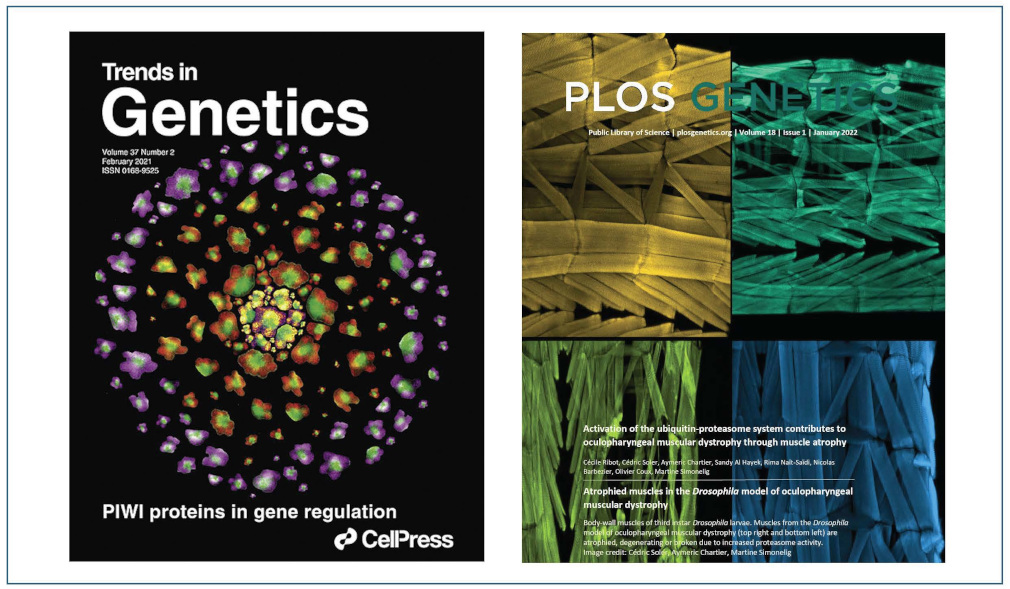
- Ribot C, Soler C, Chartier A, Al Hayek S, Naït-Saïdi R, Barbezier N, Coux O, Simonelig M (2022) Activation of the ubiquitin-proteasome system contributes to oculopharyngeal muscular dystrophy through muscle atrophy. PLoS Genetics, 18:e1010015. With cover
- Ramat A, Simonelig M (2021) Functions of PIWI Proteins in Gene Regulation: New Arrows Added to the piRNA Quiver. Trends in Genetics, doi:10.1016/j.tig.2020.08.011. Invited Review; with cover
- Bamia A, Sinane M, Naït-Saïdi R, Dhiab J, Keruzoré M, Nguyen PH, Bertho A, Soubigou F, Halliez S, Blondel M, Trollet C, Simonelig M, Friocourt G, Béringue V, Bihel F, Voisset C (2021) Anti-prion Drugs Targeting the Protein Folding Activity of the Ribosome Reduce PABPN1 Aggregation. Neurotherapeutics, 18, 1137-1150.
- Ramat A, Garcia-Silva MR, Jahan C, Naït-Saïdi R, Dufourt J, Garret C, Chartier A, Cremaschi J, Patel V, Decourcelle M, Bastide A, Juge F, Simonelig M (2020) The PIWI protein Aubergine recruits eIF3 to activate translation in the germ plasm. Cell Research, 5, 421-435. Press release at CNRS (2020)
- Rojas-Rios P, Simonelig M (2018) piRNAs and PIWI proteins: regulators of gene expression in development and stem cells. Development, 145, Invited Review
- Coll O, Guitart T, Villalba A, Papin C, Simonelig M, Gebauer F (2018) Dicer-2 promotes mRNA activation through cytoplasmic polyadenylation. RNA, 24, 529-539. Recommended by F1000
- Dufourt J, Bontonou G, Chartier A, Jahan C, Meunier A-C, Pierson S, Harrison P F, Papin C, Beilharz TH, Simonelig M (2017) piRNAs and Aubergine cooperate with Wispy poly(A) polymerase to stabilize mRNAs in the germ plasm. Nature Communications, 8, 1305
- Rojas-Rios P, Chartier A, Pierson S, Simonelig M (2017) Aubergine and piRNAs promote germline stem cell self-renewal by repressing the proto-oncogene Cbl. EMBO Journal, 36, 3194-3211.
- Götze M, Dufourt J, Ihling C, Rammelt C, Pierson S, Sambrani N, Temme C, Sinz A, Simonelig M, Wahle E (2017) Translational repression of the Drosophila nanos mRNA involves the RNA helicase Belle and RNA coating by Me31B and Trailer hitch. RNA, 23, 1552-1568.
- Barckmann B*, Pierson S*, Dufourt J*, Papin C, Armenise C, Port F, Grentzinger T, Chambeyron S, Baronian G, Desvignes J-P, Curk T, Simonelig M (2015) Aubergine iCLIP reveals piRNA-dependent decay of mRNAs involved in germ cell development in the early embryo. Cell Reports, 12, 1205-16
- Rojas-Ríos P*, Chartier A*, Pierson S, Séverac D, Dantec C, Busseau I, Simonelig M (2015) Translational control of autophagy by Orb in the Drosophila Developmental Cell, 35, 622-631
- Chartier A*, Klein P*, Pierson S, Barbezier N, Gidaro T, Casas F, Carberry S, Dowling P, Maynadier L, Bellec M, Oloko M, Jardel C, Moritz B, Dickson G, Mouly V, Ohlendieck K, Butler-Browne G, Trollet C#, Simonelig M# (2015) Mitochondrial dysfunction reveals the role of mRNA poly(A) tail regulation in oculopharyngeal muscular dystrophy pathogenesis. PLoS Genetics, 11:e1005092
- Joly W, Chartier A, Rojas-Rios P, Busseau I, Simonelig M (2013) The CCR4 deadenylase acts with Nanos and Pumilio in the fine-tuning of Mei-P26 expression to promote germline stem cell self-renewal Stem Cell Reports, 1, 411-424. With cover
- Barckmann B, Simonelig M (2013) Control of maternal mRNA stability in germ cells and early embryos. Special Issue on RNA decay mechanisms BBA-Gene Regulatory Mechanisms, 1829, 714-724. Invited Review
- Barbezier N, Chartier A, Bidet Y, Buttstedt A, Voisset C, Galons H, Blondel M, Schwarz E, Simonelig M (2011) Antiprion drugs 6-aminophenanthridine and guanabenz reduce PABPN1 toxicity and aggregation in oculopharyngeal muscular dystrophy. EMBO Molecular Medicine, 3, 35-49
- Simonelig M (2011) Developmental functions of piRNAs and transposable elements: A Drosophila point-of-view RNA Biology, 8:5. Invited Review
- Rouget C, Papin C, Boureux A, Meunier A-C, Franco B, Robine N, Lai EC, Pélisson A, Simonelig M (2010) Maternal mRNA deadenylation and decay by the piRNA pathway in the early Drosophila Nature, 467, 1128-1132. Comment in Nature Reviews Genet. (2010); Comment in Nature Reviews Mol. Cell Biol. (2010); Recommended by F1000: Exceptional.
- Temme C, Chartier A, Zhang L, Kremmer E, Ihling C, Sinz A, Simonelig M, Wahle E. (2010) Subunits of the Drosophila CCR4-NOT complex and their roles in mRNA deadenylation. RNA, 16, 1356-1370. Recommended by F1000