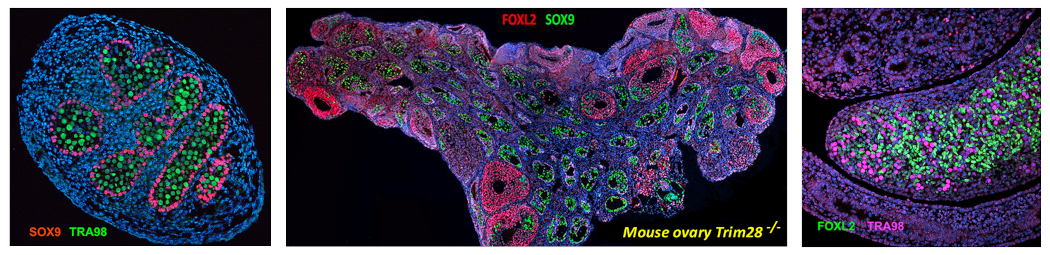
Abberbock, E., Ridnik, M., Stevant, I., Weiss, R., Bamberger, C., Ziv Lhermann, S., Lubman, M., Yao, Y.M., Afek, A., Poulat, F., and Gonen, N. (2026). A single-nucleotide enhancer mutation overrides chromosomal sex to drive XX male development. Nat Commun. Doi: 10.1038/s41467-026-71328-9.
Stévant, I., Gonen, N., and Poulat, F. (2024). Transposable elements acquire time- and sex-specific transcriptional and epigenetic signatures along mouse fetal gonad development. Frontiers in Cell and Developmental Biology 11, 1327410. Doi: 10.3389/fcell.2023.1327410.
Ridnik, M., Abberbock, E., Alipov, V., Lhermann, S.Z., Kaufman, S., Lubman, M., Poulat, F., and Gonen, N. (2024). Two redundant transcription factor binding sites in a single enhancer are essential for mammalian sex determination. Nucleic Acids Res 52, 5514–5528. Doi: 10.1093/nar/gkae178.
Boizet-Bonhoure, B., Déjardin, S., Girard, M., Durix, Q., Poulat, F., and Philibert, P. (2024). Adenomyotic Lesions Are Induced in the Mouse Uterus after Exposure to NSAID and EE2 Mixtures at Environmental Doses. International Journal of Molecular Sciences 25. Doi: 10.3390/ijms25042003.
Philibert, P., Stévant, I., Déjardin, S., Girard, M., Sellem, E., Durix, Q., Messager, A., Gonzalez, A.-A., Mialhe, X., Pruvost, A., Poulat, F., and Boizet-Bonhoure, B. (2023). Intergenerational effects on fertility in male and female mice after chronic exposure to environmental doses of NSAIDs and 17α-ethinylestradiol mixtures. Food and Chemical Toxicology 182, 114085. Doi: 10.1016/j.fct.2023.114085.
Philibert, P., Dejardin, S., Girard, M., Durix, Q., Gonzalez, A.A., Mialhe, X., Tardat, M., Poulat, F., and Boizet-Bonhoure, B. (2023). Cocktails of NSAIDs and 17alpha Ethinylestradiol at Environmentally Relevant Doses in Drinking Water Alter Puberty Onset in Mice Intergenerationally. Int J Mol Sci 24. Doi: 10.3390/ijms24065890.
Dujardin, E., Andre, M., Dewaele, A., Mandon-Pepin, B., Poulat, F., Frambourg, A., Thepot, D., Jouneau, L., Jolivet, G., Pailhoux, E., and Pannetier, M. (2023). DMRT1 is a testis-determining gene in rabbits and is also essential for female fertility. eLife 12. Doi: 10.7554/eLife.89284.
Rossitto, M., Dejardin, S., Rands, C.M., Le Gras, S., Migale, R., Rafiee, M.R., Neirijnck, Y., Pruvost, A., Nguyen, A.L., Bossis, G., Cammas, F., Le Gallic, L., Wilhelm, D., Lovell-Badge, R., Boizet-Bonhoure, B., Nef, S., and Poulat, F. (2022). TRIM28-dependent SUMOylation protects the adult ovary from activation of the testicular pathway. Nat Commun 13, 4412. Doi: 10.1038/s41467-022-32061-1.
Boizet-Bonhoure, B., Dejardin, S., Rossitto, M., Poulat, F., and Philibert, P. (2022). Using Experimental Models to Decipher the Effects of Acetaminophen and NSAIDs on Reproductive Development and Health. Front Toxicol 4, 835360. Doi: 10.3389/ftox.2022.835360.
Poulat, F., and Gonen, N. (2021). Preface to the Special Issue on The Non-Coding Genome in Sex Determination. Sex Dev 15, 293–294. Doi: 10.1159/000520367.
Poulat, F. (2021). Non-Coding Genome, Transcription Factors, and Sex Determination. Sex Dev, 1–13. Doi: 10.1159/000519725.
Philibert, P., Dejardin, S., Pirot, N., Pruvost, A., Nguyen, A.L., Bernex, F., Poulat, F., and Boizet-Bonhoure, B. (2021). In the mouse, prostaglandin D2 signalling protects the endometrium against adenomyosis. Mol Hum Reprod 27. Doi: 10.1093/molehr/gaab029.
Rossitto, M., Ollivier, M., Déjardin, S., Pruvost, A., Brun, C., Marchive, C., Nguyen, A.L., Ghettas, A., Keime, C., de Massy, B., Poulat, F., Philibert, P., and Boizet-Bonhoure, B. (2019). In utero exposure to acetaminophen and ibuprofen leads to intergenerational accelerated reproductive aging in female mice. Communications Biology 2, 310. Doi: 10.1038/s42003-019-0552-x.
Rossitto, M., Marchive, C., Pruvost, A., Sellem, E., Ghettas, A., Badiou, S., Sutra, T., Poulat, F., Philibert, P., and Boizet-Bonhoure, B. (2019). Intergenerational effects on mouse sperm quality after in utero exposure to acetaminophen and ibuprofen. FASEB J 33, 339–357. Doi: 10.1096/fj.201800488RRR.
Sreenivasan, R., Ludbrook, L., Fisher, B., Declosmenil, F., Knower, K.C., Croft, B., Bird, A.D., Ryan, J., Bashamboo, A., Sinclair, A.H., Koopman, P., McElreavey, K., Poulat, F., and Harley, V.R. (2018). Mutant NR5A1/SF-1 in patients with disorders of sex development shows defective activation of theSOX9TESCO enhancer. Human Mutation 39, 1861–1874. Doi: 10.1002/humu.23603.
Penrad-Mobayed, M., Perrin, C., L’Hote, D., Contremoulins, V., Lepesant, J.A., Boizet-Bonhoure, B., Poulat, F., Baudin, X., and Veitia, R.A. (2018). A role for SOX9 in post-transcriptional processes: insights from the amphibian oocyte. Scientific reports 8, 7191. Doi: 10.1038/s41598-018-25356-1.
Gonen, N., Futtner, C.R., Wood, S., Garcia-Moreno, S.A., Salamone, I.M., Samson, S.C., Sekido, R., Poulat, F., Maatouk, D.M., and Lovell-Badge, R. (2018). Sex reversal following deletion of a single distal enhancer of Sox9. Science 360, 1469–1473. Doi: 10.1126/science.aas9408.
Tajouri, A., Ben Gaied, D., Hizem, S., Boujelben, S., Maazoul, F., M’Rad, R., Poulat, F., and Kharrat, M. (2017). Functional Analysis of Mutations at Codon 127 of the SRY Gene Associated with 46,XY Complete Gonadal Dysgenesis. Sex Dev 11, 203–209. Doi: 10.1159/000478718.
Rahmoun, M., Lavery, R., Laurent-Chaballier, S., Bellora, N., Philip, G.K., Rossitto, M., Symon, A., Pailhoux, E., Cammas, F., Chung, J., Bagheri-Fam, S., Murphy, M., Bardwell, V., Zarkower, D., Boizet-Bonhoure, B., Clair, P., Harley, V.R., and Poulat, F. (2017). In mammalian foetal testes, SOX9 regulates expression of its target genes by binding to genomic regions with conserved signatures. Nucleic Acids Res 45, 7191–7211. Doi: 10.1093/nar/gkx328.
Bashamboo, A., Donohoue, P.A., Vilain, E., Rojo, S., Calvel, P., Seneviratne, S.N., Buonocore, F., Barseghyan, H., Bingham, N., Rosenfeld, J.A., Mulukutla, S.N., Jain, M., Burrage, L., Dhar, S., Balasubramanyam, A., Lee, B., Members of, U.D.N., Dumargne, M.C., Eozenou, C., Suntharalingham, J.P., de Silva, K., Lin, L., Bignon-Topalovic, J., Poulat, F., Lagos, C.F., McElreavey, K., and Achermann, J.C. (2016). A recurrent p.Arg92Trp variant in steroidogenic factor-1 (NR5A1) can act as a molecular switch in human sex development. Hum Mol Genet 25, 3446–3453. Doi: 10.1093/hmg/ddw186.
Rossitto, M., Ujjan, S., Poulat, F., and Boizet-Bonhoure, B. (2015). Multiple roles of the prostaglandin D2 signaling pathway in reproduction. Reproduction 149, R49–58. Doi: 10.1530/REP-14-0381.
Rossitto, M., Philibert, P., Poulat, F., and Boizet-Bonhoure, B. (2015). Molecular events and signalling pathways of male germ cell differentiation in mouse. Semin Cell Dev Biol 45, 84–93. Doi: 10.1016/j.semcdb.2015.09.014.
Rahmoun, M., Perez, J., Saunders, P.A., Boizet-Bonhoure, B., Wilhelm, D., Poulat, F., and Veyrunes, F. (2014). Anatomical and Molecular Analyses of XY Ovaries from the African Pygmy Mouse Mus minutoides. Sex Dev 8, 356–363. Doi: 10.1159/000368664.
Moniot, B., Ujjan, S., Champagne, J., Hirai, H., Aritake, K., Nagata, K., Dubois, E., Nidelet, S., Nakamura, M., Urade, Y., Poulat, F., and Boizet-Bonhoure, B. (2014). Prostaglandin D2 acts through the Dp2 receptor to influence male germ cell differentiation in the foetal mouse testis. Development 141, 3561–3571. Doi: 10.1242/dev.103408.
Philibert, P., Boizet-Bonhoure, B., Bashamboo, A., Paris, F., Aritake, K., Urade, Y., Leger, J., Sultan, C., and Poulat, F. (2013). Unilateral cryptorchidism in mice mutant for Ptgds. Hum Mutat 34, 278–282. Doi: 10.1002/humu.22231.
Sim, H., Argentaro, A., Czech, D.P., Bagheri-Fam, S., Sinclair, A.H., Koopman, P., Boizet-Bonhoure, B., Poulat, F., and Harley, V.R. (2011). Inhibition of SRY-calmodulin complex formation induces ectopic expression of ovarian cell markers in developing XY gonads. Endocrinology 152, 2883–2893. Doi: 10.1210/en.2010-1475.
Philibert, P., Paris, F., Audran, F., Kalfa, N., Polak, M., Thibaud, E., Pinto, G., Houang, M., Zenaty, D., Leger, J., Mas, J.C., Pienkowski, C., Einaudi, S., Damiani, D., Ten, S., Sinha, S., Poulat, F., and Sultan, C. (2011). Phenotypic Variation of SF1 Gene Mutations. Advances in experimental medicine and biology 707, 67–72. Doi: 10.1007/978-1-4419-8002-1_16.
Paris, F., De Ferran, K., Bhangoo, A., Ten, S., Lahlou, N., Audran, F., Servant, N., Poulat, F., Philibert, P., and Sultan, C. (2011). Isolated ‘idiopathic’ micropenis: hidden genetic defects? International journal of andrology. Doi: 10.1111/j.1365-2605.2010.01135.x.
Moniot, B., Farhat, A., Aritake, K., Declosmenil, F., Nef, S., Eguchi, N., Urade, Y., Poulat, F., and Boizet-Bonhoure, B. (2011). Hematopoietic prostaglandin D synthase (H-Pgds) is expressed in the early embryonic gonad and participates to the initial nuclear translocation of the SOX9 protein. Dev Dyn 240, 2335–2343. Doi: 10.1002/dvdy.22726.
Farhat, A., Philibert, P., Sultan, C., Poulat, F., and Boizet-Bonhoure, B. (2011). Hematopoietic-Prostaglandin D2 synthase through PGD2 production is involved in the adult ovarian physiology. J Ovarian Res 4, 3. Doi: 10.1186/1757-2215-4-3.
Abdel-Samad, R., Zalzali, H., Rammah, C., Giraud, J., Naudin, C., Dupasquier, S., Poulat, F., Boizet-Bonhoure, B., Lumbroso, S., Mouzat, K., Bonnans, C., Pignodel, C., Raynaud, P., Fort, P., Quittau-Prevostel, C., and Blache, P. (2011). MiniSOX9, a dominant-negative variant in colon cancer cells. Oncogene 30, 2493–2503. Doi: 10.1038/onc.2010.621.
Malki, S., Boizet-Bonhoure, B., and Poulat, F. (2010). Shuttling of SOX proteins. Int J Biochem Cell Biol 42, 411–416. Doi: S1357-2725(09)00276-3 [pii] 10.1016/j.biocel.2009.09.020.
Moniot, B., Declosmenil, F., Barrionuevo, F., Scherer, G., Aritake, K., Malki, S., Marzi, L., Cohen-Solal, A., Georg, I., Klattig, J., Englert, C., Kim, Y., Capel, B., Eguchi, N., Urade, Y., Boizet-Bonhoure, B., and Poulat, F. (2009). The PGD2 pathway, independently of FGF9, amplifies SOX9 activity in Sertoli cells during male sexual differentiation. Development 136, 1813–1821. Doi: 10.1242/dev.032631.
Zalzali, H., Naudin, C., Bastide, P., Quittau-Prevostel, C., Yaghi, C., Poulat, F., Jay, P., and Blache, P. (2008). CEACAM1, a SOX9 direct transcriptional target identified in the colon epithelium. Oncogene 27, 7131–7138. Doi: onc2008331 [pii] 10.1038/onc.2008.331.
Moniot, B., Boizet-Bonhoure, B., and Poulat, F. (2008). Male specific expression of lipocalin-type prostaglandin D synthase (cPTGDS) during chicken gonadal differentiation: relationship with cSOX9. Sex Dev 2, 96–103. Doi: 10.1159/000129694.
Malki, S., Declosmenil, F., Farhat, A., Moniot, B., Poulat, F., and Boizet-Bonhoure, B. (2008). [Prostaglandin D2: new roles in the embryonic and pathological gonad]. Med Sci (Paris) 24, 177–183.
Manuylov, N.L., Fujiwara, Y., Adameyko, II, Poulat, F., and Tevosian, S.G. (2007). The regulation of Sox9 gene expression by the GATA4/FOG2 transcriptional complex in dominant XX sex reversal mouse models. Dev Biol 307, 356–367. Doi: 10.1016/j.ydbio.2007.04.040.
Malki, S., Bibeau, F., Notarnicola, C., Roques, S., Berta, P., Poulat, F., and Boizet-Bonhoure, B. (2007). Expression and biological role of the prostaglandin D synthase/SOX9 pathway in human ovarian cancer cells. Cancer Lett 255, 182–193. Doi: S0304-3835(07)00195-4 [pii] 10.1016/j.canlet.2007.04.007.
Notarnicola, C., Malki, S., Berta, P., Poulat, F., and Boizet-Bonhoure, B. (2006). Transient expression of SOX9 protein during follicular development in the adult mouse ovary. Gene Expr Patterns 6, 695–702.
Kim, Y., Kobayashi, A., Sekido, R., DiNapoli, L., Brennan, J., Chaboissier, M.C., Poulat, F., Behringer, R.R., Lovell-Badge, R., and Capel, B. (2006). Fgf9 and Wnt4 act as antagonistic signals to regulate mammalian sex determination. PLoS Biol 4, e187. Doi: 10.1371/journal.pbio.0040187.
Charrasse, S., Comunale, F., Grumbach, Y., Poulat, F., Blangy, A., and Gauthier-Rouviere, C. (2006). RhoA GTPase regulates M-cadherin activity and myoblast fusion. Mol Biol Cell 17, 749–759. Doi. 10.1091/mbc.e05-04-0284
Thevenet, L., Albrecht, K.H., Malki, S., Berta, P., Boizet-Bonhoure, B., and Poulat, F. (2005). NHERF2/SIP-1 interacts with mouse SRY via a different mechanism than human SRY. J Biol Chem 280, 38625–38630. Doi: 10.1074/jbc.M504127200.
Saffin, J.M., Venoux, M., Prigent, C., Espeut, J., Poulat, F., Giorgi, D., Abrieu, A., and Rouquier, S. (2005). ASAP, a human microtubule-associated protein required for bipolar spindle assembly and cytokinesis. Proc Natl Acad Sci U S A 102, 11302–11307. Doi. 10.1073/pnas.0500964102
Malki, S., Nef, S., Notarnicola, C., Thevenet, L., Gasca, S., Mejean, C., Berta, P., Poulat, F., and Boizet-Bonhoure, B. (2005). Prostaglandin D2 induces nuclear import of the sex-determining factor SOX9 via its cAMP-PKA phosphorylation. EMBO J 24, 1798–1809. Doi: 10.1038/sj.emboj.7600660.
Malki, S., Berta, P., Poulat, F., and Boizet-Bonhoure, B. (2005). Cytoplasmic retention of the sex-determining factor SOX9 via the microtubule network. Exp Cell Res 309, 468–475. Doi: 10.1016/j.yexcr.2005.07.005.
Thevenet, L., Mejean, C., Moniot, B., Bonneaud, N., Galeotti, N., Aldrian-Herrada, G., Poulat, F., Berta, P., Benkirane, M., and Boizet-Bonhoure, B. (2004). Regulation of human SRY subcellular distribution by its acetylation/deacetylation. EMBO J 23, 3336–3345. Doi: 10.1038/sj.emboj.7600352.
Gasca, S., Boizet-Bonhoure, B., Poulat, F., and Berta, P. (2003). Sex determination in mammals: a traffic update? Med Sci (Paris) 19, 25–26. Doi. 10.1051/medsci/200319125
Zhou, R., Bonneaud, N., Yuan, C.X., de Santa Barbara, P., Boizet, B., Schomber, T., Scherer, G., Roeder, R.G., Poulat, F., and Berta, P. (2002). SOX9 interacts with a component of the human thyroid hormone receptor-associated protein complex. Nucleic Acids Res 30, 3245–3252. Doi: 10.1093/nar/gkf443.
Gasca, S., Canizares, J., De Santa Barbara, P., Mejean, C., Poulat, F., Berta, P., and Boizet-Bonhoure, B. (2002). A nuclear export signal within the high mobility group domain regulates the nucleocytoplasmic translocation of SOX9 during sexual determination. Proc Natl Acad Sci U S A 99, 11199–11204. Doi: 10.1073/pnas.172383099.
Ukiyama, E., Jancso-Radek, A., Li, B., Milos, L., Zhang, W., Phillips, N.B., Morikawa, N., King, C.Y., Chan, G., Haqq, C.M., Radek, J.T., Poulat, F., Donahoe, P.K., and Weiss, M.A. (2001). SRYand architectural gene regulation: the kinetic stability of a bent protein-DNA complex can regulate its transcriptional potency. Mol Endocrinol 15, 363–377. Doi: 10.1210/mend.15.3.0621.
Takash, W., Canizares, J., Bonneaud, N., Poulat, F., Mattei, M.G., Jay, P., and Berta, P. (2001). SOX7 transcription factor: sequence, chromosomal localisation, expression, transactivation and interference with Wnt signalling. Nucleic Acids Res 29, 4274–4283. Doi. 10.1093/nar/29.21.4274
Pfeifer, D., Poulat, F., Holinski-Feder, E., Kooy, F., and Scherer, G. (2000). The SOX8 gene is located within 700 kb of the tip of chromosome 16p and is deleted in a patient with ATR-16 syndrome. Genomics 63, 108–116. Doi: 10.1006/geno.1999.6060.
Moniot, B., Berta, P., Scherer, G., Sudbeck, P., and Poulat, F. (2000). Male specific expression suggests role of DMRT1 in human sex determination. Mech Dev 91, 323–325. Doi: 10.1016/s0925-4773(99)00267-1.
de Santa Barbara, P., Moniot, B., Poulat, F., and Berta, P. (2000). Expression and subcellular localization of SF-1, SOX9, WT1, and AMH proteins during early human testicular development. Dev Dyn 217, 293–298. Doi: 10.1002/(SICI)1097-0177(200003)217:3<293::AID-DVDY7>3.0.CO;2-P.
Soullier, S., Jay, P., Poulat, F., Vanacker, J.M., Berta, P., and Laudet, V. (1999). Diversification pattern of the HMG and SOX family members during evolution. J Mol Evol 48, 517–527. Doi: 10.1007/pl00006495.
Berta, P., de Santa Barbara, P., Boizet, B., Bonneaud, N., Moniot, B., and Poulat, F. (1999). [Sex determination in mammals: state of the art]. Contracept Fertil Sex 27, 423–433. PMID: 10431448
Poulat, F., Desclozeaux, M., Tuffery, S., Jay, P., Boizet, B., and Berta, P. (1998). Mutation in the 5′ noncoding region of the SRY gene in an XY sex-reversed patient. Hum Mutat Suppl 1, S192–194. Doi: 10.1002/humu.1380110162.
Poulat, F., Desclozeaux, M., de Santa Barbara, P., Capony, J.P., Turowski, P., Jay, P., Mejean, C., Moniot, B., Boizet, B., and Berta, P. (1998). Phosphorylation of an N-terminal motif enhances DNA-binding activity of the human SRY protein. J Biol Chem 273, 7988–7995. Doi: 10.1074/jbc.273.14.7988.
Klamt, B., Koziell, A., Poulat, F., Wieacker, P., Scambler, P., Berta, P., and Gessler, M. (1998). Frasier syndrome is caused by defective alternative splicing of WT1 leading to an altered ratio of WT1 +/-KTS splice isoforms. Hum Mol Genet 7, 709–714. Doi: 10.1093/hmg/7.4.709.
Desclozeaux, M., Poulat, F., de Santa Barbara, P., Soullier, S., Jay, P., Berta, P., and Boizet-Bonhoure, B. (1998). Characterization of two Sp1 binding sites of the human sex determining SRY promoter. Biochim Biophys Acta 1397, 247–252. Doi: 10.1016/s0167-4781(98)00041-4.
de Santa Barbara, P., Moniot, B., Poulat, F., Boizet, B., and Berta, P. (1998). Steroidogenic factor-1 regulates transcription of the human anti-mullerian hormone receptor. J Biol Chem 273, 29654–29660. Doi: 10.1074/jbc.273.45.29654.
De Santa Barbara, P., Bonneaud, N., Boizet, B., Desclozeaux, M., Moniot, B., Sudbeck, P., Scherer, G., Poulat, F., and Berta, P. (1998). Direct interaction of SRY-related protein SOX9 and steroidogenic factor 1 regulates transcription of the human anti-Mullerian hormone gene. Mol Cell Biol 18, 6653–6665. Doi: 10.1128/MCB.18.11.6653.
Poulat, F., de Santa Barbara, P., Desclozeaux, M., Soullier, S., Moniot, B., Bonneaud, N., Boizet, B., and Berta, P. (1997). The human testis determining factor SRY binds a nuclear factor containing PDZ protein interaction domains. J Biol Chem 272, 7167–7172. Doi: 10.1074/jbc.272.11.7167.
Jay, P., Sahly, I., Goze, C., Taviaux, S., Poulat, F., Couly, G., Abitbol, M., and Berta, P. (1997). SOX22 is a new member of the SOX gene family, mainly expressed in human nervous tissue. Hum Mol Genet 6, 1069–1077. Doi.
Carillo, S., Pariat, M., Steff, A., Jariel-Encontre, I., Poulat, F., Berta, P., and Piechaczyk, M. (1996). PEST motifs are not required for rapid calpain-mediated proteolysis of c-fos protein. Biochem J 313 ( Pt 1), 245–251. Doi: 10.1042/bj3130245.
Poulat, F., Girard, F., Chevron, M.P., Goze, C., Rebillard, X., Calas, B., Lamb, N., and Berta, P. (1995). Nuclear localization of the testis determining gene product SRY. J Cell Biol 128, 737–748. Doi: 10.1083/jcb.128.5.737.
Soullier, S., Poulat, F., Boizet-Bonhoure, B., Calas, B., Bennes, R., Heitz, F., and Berta, P. (1994). The human testis determining factor SRY: a new member of the HMG box protein family. Biochimie 76, 1075–1081. Doi: 10.1016/0300-9084(94)90033-7.
Poulat, F., Soullier, S., Goze, C., Heitz, F., Calas, B., and Berta, P. (1994). Description and functional implications of a novel mutation in the sex-determining gene SRY. Hum Mutat 3, 200–204. Doi: 10.1002/humu.1380030305.
Poulat, F., Goze, C., Boizet, B., and Berta, P. (1994). [Human testicular determining factor: from the gene to protein]. Ann Endocrinol (Paris) 54, 307–314. PMID : 7916179
Poulat, F., Morin, D., Konig, A., Brun, P., Giltay, J., Sultan, C., Dumas, R., Gessler, M., and Berta, P. (1993). Distinct molecular origins for Denys-Drash and Frasier syndromes. Hum Genet 91, 285–286. Doi: 10.1007/bf00218274.
Goze, C., Poulat, F., and Berta, P. (1993). Partial cloning of SOX-11 and SOX-12, two new human SOX genes. Nucleic Acids Res 21, 2943. Doi: 10.1093/nar/21.12.2943.
Poulat, F., Guichard, G., Goze, C., Heitz, F., Calas, B., and Berta, P. (1992). Synthesis of a large peptide mimicking the DNA binding properties of the sex determining protein, SRY. FEBS Lett 309, 385–388. Doi: 10.1016/0014-5793(92)80812-u.
Berta, P., Morin, D., Poulat, F., Taviaux, S., Lobaccaro, J.M., Sultan, C., and Dumas, R. (1992). Molecular analysis of the sex-determining region from the Y chromosome in two patients with Frasier syndrome. Horm Res 37, 103–106. Doi: 10.1159/000182291.
Sultan, C., Lobaccaro, J.M., Medlej, R., Poulat, F., and Berta, P. (1991). SRY and male sex determination. Horm Res 36, 1–3. Doi: 10.1159/000182096.
Poulat, F., and Berta, P. (1991). [Determination of sex and Y chromosome]. Ann Endocrinol (Paris) 52, 410–414. PMID: 1824492
Manzoni, O.J., Poulat, F., Do, E., Sahuquet, A., Sassetti, I., Bockaert, J., and Sladeczek, F.A. (1991). Pharmacological characterization of the quisqualate receptor coupled to phospholipase C (Qp) in striatal neurons. Eur J Pharmacol 207, 231–241. Doi: 10.1016/0922-4106(91)90035-g.
Manzoni, O., Fagni, L., Pin, J.P., Rassendren, F., Poulat, F., Sladeczek, F., and Bockaert, J. (1990). (trans)-1-amino-cyclopentyl-1,3-dicarboxylate stimulates quisqualate phosphoinositide-coupled receptors but not ionotropic glutamate receptors in striatal neurons and Xenopus oocytes. Mol Pharmacol 38, 1–6. PMID: 2164627