
Research teams
Genome dynamics department
Nuclear architecture in physiology and pathology

Understanding the Architecture of the Nucleus – From Physiology to Pathology
Our research team, investigates how the three-dimensional organization of the cell nucleus contributes to gene regulation, genome stability, cellular identity, and disease development.
At the heart of every eukaryote cell lies the nucleus that houses the genetic material. Far from being a simple container for DNA, the nucleus is intricately organized: chromosomes occupy specific territories, chromatin folds into distinct domains, and various nuclear compartments (including our current favourite : the nuclear pore complexes !) orchestrate essential processes such as transcription or DNA repair.
We aim to decipher how this nuclear architecture is established, maintained, and remodeled in response to physiological cues and during pathological conditions.
Lab Culture
We care deeply not only about what we study, but also how we work together — with kindness, integrity, and a shared commitment to creating a safe, inclusive, and inspiring space for science and personal growth.
We are committed to the SAFE Labs initiative. Therefore, we have a Lab’s SAFE Guide that can be consulted here.
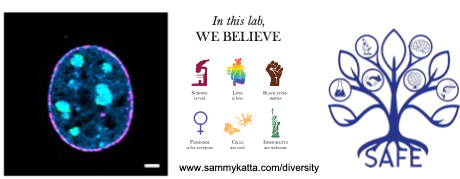
Nuclear pore complexes in chromatin organization
One remarkable feature observed in most mammalian somatic cells is the accumulation of heterochromatin at the nuclear periphery. This layer of heterochromatin at the nuclear periphery is however not continuous and is interrupted in front of the nuclear pores, forming so-called heterochromatin exclusion zones. These heterochromatin exclusion zones are present in all eukaryotic cells. How they are formed and maintained – and whether they are important for cellular functions – is unknown. We address the mechanisms underlying the maintenance of heterochromatin exclusion zones at nuclear pores. In particular, our recent results indicate that biomolecular condensates at the nuclear pore basket physically exclude heterochromatin.
Regulation of nucleocytoplasmic transport by chromatin organization
Heterochromatin exclusion has been hypothesized to be necessary for proper nucleocytoplasmic transport. While DNA density is higher in heterochromatin than in euchromatin, the global density of heterochromatin and euchromatin domains including proteins and RNAs is only mildly different. Whether heterochromatin exclusion at nuclear pores is necessary for proper nucleocytoplasmic transport dynamics and/or specificity is not known. We study how chromatin organization impacts protein and mRNA export speed, penetration into the nuclear pores and/or percentage of abortive export events.
Nuclear pore plasticity in the epithelial to mesenchymal transition
The epithelial to mesenchymal transition (EMT) is a transdifferentiation process in which epithelial cells change identity to become mesenchymal. In tumours, the EMT participates in metastasis formation through the transition of malignant epithelial cells into a less differentiated, motile and invasive state. While nuclear pore complexes have long been seen as static structures, they are now increasingly recognized as dynamic assemblies whose composition and conformation vary with differentiation, stress, and disease. We aim to describe nuclear pores plasticity during the EMT and to understand how this plasticity participates in cell identity and metastasis formation.
Methods used in our lab
Our lab uses an interdisciplinary approach to assess fundamental nuclear functions. Some of our favourite approaches include nuclear positioning editing (forcing the localization of genomic regions or proteins to specific nuclear compartments- check our iCRISPR GHoST method to target a protein of interest to heterochromatin domains in mouse cells here), super-resolution imaging, genomics, optogenetics and live-cell imaging. In particular, we aim to develop new methods to study nucleocytoplasmic transport dynamics (check our image analysis pipeline for optogenetics-based assays of transport here)


- Narat, Z., Figueroa, S., Doucet, C., and Boumendil, C. (2025). Biomolecular condensates at the nuclear pore basket maintain global chromatin organization. bioRxiv, 2025.07.18.665545.
- Donjon, A., and Boumendil, C. (2025). Using LEXY and LINuS Optogenetics Tools and Automated Image Analysis to Quantify Nucleocytoplasmic Transport Dynamics in Live Cells. JoVE, e68585.
- Bartlett, B.M., Kumar, Y., Boyle, S., Chowdhury, T., Quintanilla, A., Boumendil, C., Acosta, J.C., and Bickmore, W.A. (2024). TPR is required for cytoplasmic chromatin fragment formation during senescence. eLife 13, e101702.
- Nobari, P., Doye, V., and Boumendil, C. (2023). Metazoan nuclear pore complexes in gene regulation and genome stability. DNA Repair (Amst) 130, 103565.
Some of Charlene’s previous publications as a postdoc and PhD student:
Note that in publications prior to 2017, Charlene appears as C. Lemaitre
ORCID : https://orcid.org/0000-0002-1953-3902
- Olley, G., Pradeepa, M.M., Grimes, G.R., Piquet, S., Polo, S.E., FitzPatrick, D.R., Bickmore, W.A., and Boumendil, C. (2021). Cornelia de Lange syndrome-associated mutations cause a DNA damage signalling and repair defect. Nat Commun 12, 3127.
- Boumendil, C., Hari, P., Olsen, K.C.F., Acosta, J.C., and Bickmore, W.A. (2019). Nuclear pore density controls heterochromatin reorganization during senescence. Genes Dev. 33, 144–149.
- Lemaître, C., Grabarz, A., Tsouroula, K., Andronov, L., Furst, A., Pankotai, T., Heyer, V., Rogier, M., Attwood, K.M., Kessler, P., et al. (2014). Nuclear position dictates DNA repair pathway choice. Genes Dev., gad.248369.114.
- Lemaître, C., Fischer, B., Kalousi, A., Hoffbeck, A.-S., Guirouilh-Barbat, J., Shahar, O.D., Genet, D., Goldberg, M., Betrand, P., Lopez, B., et al. (2012). The nucleoporin 153, a novel factor in double-strand break repair and DNA damage response. Oncogene 31, 4803–4809.